For the A2 music promo package brief, I created a music video for Astrid S's "Bloodstream" (2017), a downbeat 'electropop' track with fast-paced sections, a website for Astrid S and a digipak for her fake new album that I created and named 'Bloodstream'.
For this question I decided to firstly create an interview between me and my mum: my mum playing the role of the presenter/interviewer and me playing the role of a book author who has just recently published a book about electropop genre conventions within music videos, albums (either jewel case, vinyl or digipak) and websites. Secondly I decided to create three influences videos, one which takes you through all my influences for my music video, one which takes you through all my influences for my website and finally one which takes you through all my influences for my digipak. Thirdly, I decided to create a video mimicking the 'Top of the Pops' with the top 10 music video conventions.
INTERVIEW WITH BOOK AUTHOR
...
...
INFLUENCES VIDEO FOR MY DIGIPAK
...
...
INFLUENCES VIDEO FOR MY WEBSITE
...
INFLUENCES VIDEO FOR MY WEBSITE
...
...
I SAW I DID/INFLUENCES VIDEO FOR MY MUSIC VIDEO
...
I SAW I DID/INFLUENCES VIDEO FOR MY MUSIC VIDEO
...
...
TOP OF THE POPS CONVENTIONS VIDEO
...
...
Here is a bulleted list of general music video conventions:


Special Effects (SFX)

The Script:
The first thing I will look at is Locations. There were many videos I looked at which inspired me location wise. The first one was the original video for the song I have chosen to make a music video for Astrid S - Bloodstream. I really liked the location of a city in Indonesia. You can denote skyscrapers, buildings, urban sidewalks, zebra crossings, pavements, roads etc.
The second video I was influenced by is Chase Atlantic's Triggered video. Again, the location for the video was a city. You see moving tracking shots of the city from the view of a car and out of a car window. I love how the shots are moving shots. I tried to include some moving shots of a city in my music video by sitting in a car with the camera sticking out of the window while the car is moving.
Third video I was influenced by for location is Halsey - Ghost. This video is set in an urban unidentified city even though there are chinese signifiers due to the chinese writing seen on the buildings in the video. The city is left as unidentified in order to emphasize the world of the artist who is a character in a fictional, conceptualised world within the video.
Fourth video I was inspired by for location is Jakwob's Somebody New. You denote a young woman in her 20s strolling around a city or urban area at night time trying to move on and forget a lover. She then enters a club and dances away to forget her ex lover. This is where I got the idea to create a club scene for my music video.
Moving on to underwater shots and scenes. I was influenced by several videos to do underwater filming such as the fan made video for Bring me the horizon's 'Run'. You see shots of a man in a bath with his eyes closed underwater. You also see him splash water on his face and of him swimming underwater. And as you can see I tried to recreate some of the shots used in this music video for example ECUs and Close ups of the girl's face underwater with her eyes closed. Another video which does this is Bring Me the Horizon's fan made video for 'Deathbeds'. You see a woman underwater swimming and lip syncing in a dress. I was influenced by that video too as you can see here, my mum found an old dress in our house that she no longer wears and said I can use it for the filming underwater, it was the perfect fabric I had in mind and flouncy which is exactly what I wanted.
Third video I was influenced by to have underwater footage is Seven Lions' Days To Come. Yet again you see a female character underwater swimming, turning around and twirling in a dress. Many videos I found that had underwater footage had a female character underwater usually always wearing a flouncy, big dress which floated very easily and draped out underwater.
Another video I was influenced by for underwater footage was Astrid S's 2AM. There are shots of the singer underwater in black water with a pink light shining on her from above. I really liked the idea of the colourful lighting effect on someone underwater but practically this was just to complex of a thing to do because I am not trained in lighting and did not have access to a private pool to create that complex setup. As you can see here I tried to recreate some of the shots from this video in my own video. I was able to get the permission to film in a pool but only for 30 minutes so I couldn't take that many shots.
Moving onto colour correction and use of colour gels in music videos, I was influenced by firstly the video Halsey - Ghost. In this video as you can see there is frequent heavy use of colour correction and colourful lighting. This is a very common convention of the electropop genre. I therefore tried to use a lot of colour correction and colourful lighting in my music video - as you can see here I used colour gels to create a red/purple effect on the footage. Also, the flashing colourful lights in the club helped to create this effect too as you can see with the blue colour on the club footage.
I was also influenced by the colour correction and lighting in the videos for Astrid S - Such A Boy, Tove Lo - Disco Tits, Marshmello - Spotlight and Somewhere Else - Move Together.
_________________________________________________________________________
The first thing I will look at is Locations. There were many videos I looked at which inspired me location wise. The first one was the original video for the song I have chosen to make a music video for Astrid S - Bloodstream. I really liked the location of a city in Indonesia. You can denote skyscrapers, buildings, urban sidewalks, zebra crossings, pavements, roads etc.
The second video I was influenced by is Chase Atlantic's Triggered video. Again, the location for the video was a city. You see moving tracking shots of the city from the view of a car and out of a car window. I love how the shots are moving shots. I tried to include some moving shots of a city in my music video by sitting in a car with the camera sticking out of the window while the car is moving.
Third video I was influenced by for location is Halsey - Ghost. This video is set in an urban unidentified city even though there are chinese signifiers due to the chinese writing seen on the buildings in the video. The city is left as unidentified in order to emphasize the world of the artist who is a character in a fictional, conceptualised world within the video.
Fourth video I was inspired by for location is Jakwob's Somebody New. You denote a young woman in her 20s strolling around a city or urban area at night time trying to move on and forget a lover. She then enters a club and dances away to forget her ex lover. This is where I got the idea to create a club scene for my music video.
Moving on to underwater shots and scenes. I was influenced by several videos to do underwater filming such as the fan made video for Bring me the horizon's 'Run'. You see shots of a man in a bath with his eyes closed underwater. You also see him splash water on his face and of him swimming underwater. And as you can see I tried to recreate some of the shots used in this music video for example ECUs and Close ups of the girl's face underwater with her eyes closed. Another video which does this is Bring Me the Horizon's fan made video for 'Deathbeds'. You see a woman underwater swimming and lip syncing in a dress. I was influenced by that video too as you can see here, my mum found an old dress in our house that she no longer wears and said I can use it for the filming underwater, it was the perfect fabric I had in mind and flouncy which is exactly what I wanted.
Third video I was influenced by to have underwater footage is Seven Lions' Days To Come. Yet again you see a female character underwater swimming, turning around and twirling in a dress. Many videos I found that had underwater footage had a female character underwater usually always wearing a flouncy, big dress which floated very easily and draped out underwater.
Another video I was influenced by for underwater footage was Astrid S's 2AM. There are shots of the singer underwater in black water with a pink light shining on her from above. I really liked the idea of the colourful lighting effect on someone underwater but practically this was just to complex of a thing to do because I am not trained in lighting and did not have access to a private pool to create that complex setup. As you can see here I tried to recreate some of the shots from this video in my own video. I was able to get the permission to film in a pool but only for 30 minutes so I couldn't take that many shots.
Moving onto colour correction and use of colour gels in music videos, I was influenced by firstly the video Halsey - Ghost. In this video as you can see there is frequent heavy use of colour correction and colourful lighting. This is a very common convention of the electropop genre. I therefore tried to use a lot of colour correction and colourful lighting in my music video - as you can see here I used colour gels to create a red/purple effect on the footage. Also, the flashing colourful lights in the club helped to create this effect too as you can see with the blue colour on the club footage.
I was also influenced by the colour correction and lighting in the videos for Astrid S - Such A Boy, Tove Lo - Disco Tits, Marshmello - Spotlight and Somewhere Else - Move Together.
_________________________________________________________________________
TOP OF THE POPS CONVENTIONS VIDEO
...
...
I mixed two of Firth's basic video types, performance and narrative, and had a female protagonist leading my narrative on a journey of grief after a breakup. She sees flashbacks of her ex and of them together in all the places that they used to go to.
Here is a bulleted list of general music video conventions:
1. Narrative, Performance and Concept, 3 video types (Simon Firth)
2. Linear or Fragmented Narrative (Todorov)
3. Andrew Goodwin's 6 Features of Music Videos:
- Display genre characteristics
- Relationship between visuals and lyrics
- Relationship between music and visuals
- Lots of close ups of artist used, artist may develop their own visual style which recurs across their work.
- Notion of looking (mirrors, screens within screens), voyeuristic treatment of female body.
- Intertextual references to films, TV, other music videos.
4. Presence of titles (diegetic or intertitles)
5. Costume changes, multiple locations used
6. Laura Mulvey's 'male gaze' is exploited
7. Special effects (SFX) are commonly used e.g. slow motion or layering.
8. Diegetic intro and/or outro.
I will split the conventions up with the headings:
I will split the conventions up with the headings:
- Intertextuality
- Narrative
- Lip Syncing Performance
- Titles
- Costume Changes, Multiple Locations used
- Special Effects (SFX)
- Genre Characteristics
- Notion of Looking
- Lots of Close Ups of Artist
- Relationship between visuals and lyrics
- Relationship between music and visuals
- Diegetic intro and/or outro
Intertextuality
Intertextuality is used to widen secondary audience appeal, especially an older secondary audience appeal. For example a music video that has clear intertextuality is blackbear's 'do re mi' (feat. Gucci Mane). The intertextual reference is to the film 'The Sound of Music'.
 |
| blackbear's 'do re mi' (feat. Gucci Mane) |
I have some intertextual references in my music video. One of them is to the existing music video for the song I chose: 'Astrid S - Bloodstream'. I was heavily inspired by that video.
 |
| Astrid S's 'Bloodstream' |
Narrative
Narrative in my video
Narrative in my video
I created a linear narrative which consisted of a male and female protagonist who were at first a happy couple, which I denoted through the footage of them doing things together such as kissing, sitting together on a bench talking, talking while eating in a fast food place, going swimming then kissing underwater and going to the cinema together. Towards the end of the video, they breakup, this is denoted in the shots of the couple having a heated argument outside with lots of hand gestures, then the girl physically pushes the boy away, then he puts his hands up, shouting, which leads to him walking away leaving her all alone.
Other elements of my narrative include the female main protagonist strolling through a city at night all alone after the breakup with smudged make-up connoting that she has been crying/is crying.
Lip Syncing Performance
This is the most common convention and the most important feature of a music video. If the lip-syncing does not achieve verisimilitude it won't look very good.
I decided that I wanted to be the singer/artist in my music video because then everything could look and be exactly how I planned and I'd be sure the lip syncing is how I would want it to look like: clear and synced with the music. I realised it would look achieve more realism if I actually sang with the song while I filmed myself lip syncing, therefore, it actually looks like I'm singing.
Presence of Titles
I decided not to include titles in my music video, even though after looking at many examples I found that most of them had titles at the start such as MØ's 'Kamikaze', Somewhere Else's 'Move Together' and Astrid S's 'Such A Boy'.
The Astrid S example had the artist title and the track title. The font is in neon colours and has sci-fi connotations due to the laser effect you can see.
Costume Changes, Multiple Locations Used
I used many different costumes for my characters in my music video. This is a common convention in general genre music videos and electro pop genre music videos.
 For the performance footage, I made my artist (me) wear many different costumes throughout. The first was a lilac slightly turtle neck mesh see through crop top with dark red lipstick, blonde hair, nose ring and black eyeliner.
 The second costume was blonde/green hair with green spectacle rounded glasses, black eyeliner, nose ring, a black t-shirt and dark red lipstick.
 The third costume for performance was a black, red and white tight crop top (from 'O'Mighty' - alternative fashionable clothing store in Singapore), pink straight hair, black eyeliner, pink eyeshadow, a see through clear heart choker and skin colour/pink lipstick.
 The costumes I decided that the female protagonist would wear are light, relaxed clothes to connote how carefree and relaxed the female character was when she was in the relationship with her ex boyfriend. As you can see in the intimate shots she wears purple Kappa sweatpants and a small crop top.

Here she wears a white simple top and has pink hair. I also wanted to show that this couple had been together for many years, to do this I decided that the female character would change colour hair - to connote passage of time or ellipsis. So in the image above, she has blonde hair (which was actually a wig) and in this image she has pink hair.
 I decided that the costume for the main female protagonist after the breakup would be slightly different to the main female protagonist before the breakup (still in the couple). I decided that she would have more of a rebel, dark look to her after the breakup to show that she is sad and angry. I chose her to wear black smudged heavy eye make-up (mascara, eyeliner, eyeshadow) to connote that she has been crying.
Laura Mulvey's 'male gaze' is exploited
Lip Syncing Performance
This is the most common convention and the most important feature of a music video. If the lip-syncing does not achieve verisimilitude it won't look very good.
I decided that I wanted to be the singer/artist in my music video because then everything could look and be exactly how I planned and I'd be sure the lip syncing is how I would want it to look like: clear and synced with the music. I realised it would look achieve more realism if I actually sang with the song while I filmed myself lip syncing, therefore, it actually looks like I'm singing.
Presence of Titles
 |
| MØ - Kamikaze |
 |
| Astrid S - Such A Boy |
 |
| Somewhere Else - Move Together |
I used many different costumes for my characters in my music video. This is a common convention in general genre music videos and electro pop genre music videos.
 For the performance footage, I made my artist (me) wear many different costumes throughout. The first was a lilac slightly turtle neck mesh see through crop top with dark red lipstick, blonde hair, nose ring and black eyeliner.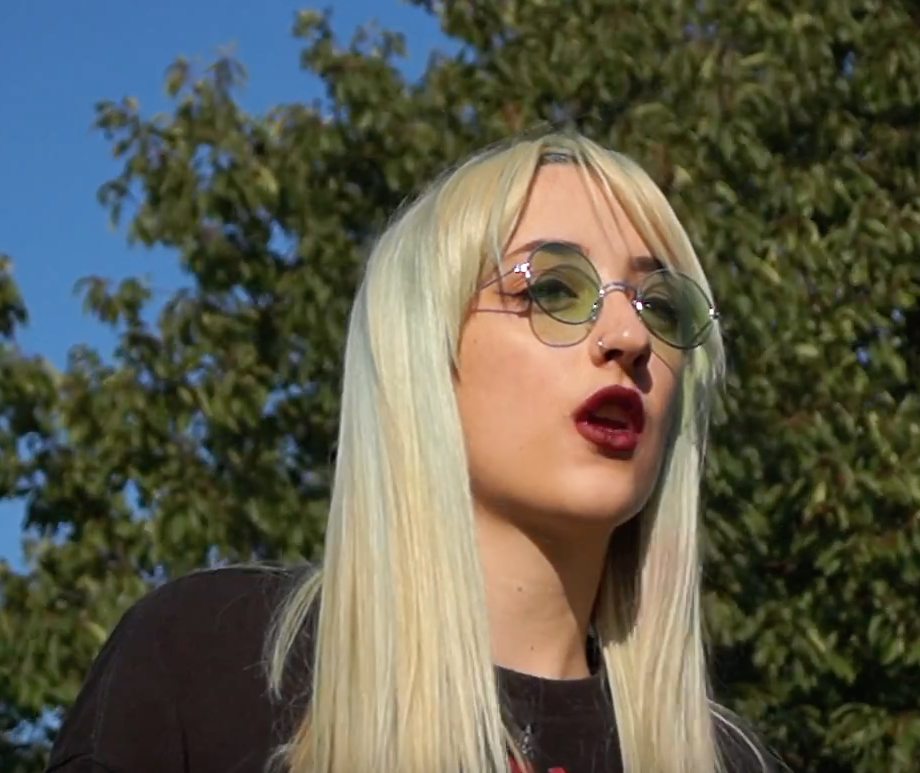


Here she wears a white simple top and has pink hair. I also wanted to show that this couple had been together for many years, to do this I decided that the female character would change colour hair - to connote passage of time or ellipsis. So in the image above, she has blonde hair (which was actually a wig) and in this image she has pink hair.

Laura Mulvey's 'male gaze' is exploited

I exploited Laura Mulvey's 'male gaze' by having objectifying shots of the female character e.g. when she is doing intimate things with the male character. As I have stated in the influences video for my music video, for the intimate shots of the couple, I was inspired by the music videos: Halsey - Ghost, Drumsound and Bassline Smith - Through The Night and Somewhere Else - Move Together. These videos all include intimate shots of a couple doing things together either slightly sexually or romantically. As you can see I included CU shots of the male character touching the girl's body which is evidently objectifying.


Special Effects (SFX)
I used a variety of special effects in my entire promo package, especially for the digipak. For the digipak, I watched many photoshop tutorials on YouTube on how to create certain effects e.g. Double Exposure effect, Distortion effect, Glitch effect and a colourful layer glitch effect. I decided in the end on using the double exposure effect on the main image on the front panel/cover as you can see here -

I double exposed two screenshot images of city streets from the music video I made, over a Medium shot image of the artist, Astrid S (aka me). I specifically made sure that one of the image screenshots covered all the hair sections only then I made sure the other image screenshot covered all the top that the artist is wearing.
In terms of the music video, I used many different special effects such as layering, greenscreen, colour correction, filters etc.

 I was influenced to use the special effect of colour correction from the music video examples Halsey - Ghost, Somewhere Else - Move Together, Marshmellow - Spotlight and Astrid S - Such A Boy. Colour correction is a common convention of the electropop genre so that is why I included it into my video.

As you can see on the left, I also experimented with the use of layering, I really liked the effect it created on the footage. I was inspired to include layering after looking at the example Chase Atlantic - Swim, Halsey - Ghost and Chase Atlantic - Triggered.
I really liked the Halsey example because of how there is a shot of a city layered over one of the female character's faces. I was really inspired by that example.
In terms of the music video, I used many different special effects such as layering, greenscreen, colour correction, filters etc.

 I was influenced to use the special effect of colour correction from the music video examples Halsey - Ghost, Somewhere Else - Move Together, Marshmellow - Spotlight and Astrid S - Such A Boy. Colour correction is a common convention of the electropop genre so that is why I included it into my video.
 |
| Chase Atlantic - Swim |
 |
| Halsey - Ghost |
I really liked the Halsey example because of how there is a shot of a city layered over one of the female character's faces. I was really inspired by that example.
 |
| Chase Atlantic - Triggered |


