Showing posts with label industry. Show all posts

Monday, 2 April 2018

EVALUATION Q3b: Distribution

EVALUATION Q3b: How would they be distributed as real media products?
For this question, I decided to do 3 creative things. Firstly, I created a 'Mastermind' video where my stepdad, Fred, is one of the contenders for the show answering questions on his specialist subject, the music industry. 

Secondly I created a 'Midnight Game Show' mimicking 
Michael Mcintyre's 'Midnight Game Show' from his 'Big 
Show'. What happens in the Midnight Game Show is basically Michael Mcintyre comes into someone's house in the middle of the night and comes through the bedroom door of the person who is sleeping then wakes them up and asks them very random questions testing to see how fast or well their brain works after just being woken up disturbed. The people who have been woken up are not aware of this happening, someone close to the person (e.g. partner or family member) signs the person up to be on the show. 

Thirdly I have created a powerpoint presentation which addresses the bulk of the question. 

MASTERMIND VIDEO
...

...
The Script:

Tuesday, 6 March 2018

INDUSTRY: BBFC Age Ratings

HOW I CAN APPLY THIS RESEARCH:
After doing this research I started to think what the BBFC age rating would be for my music video for the track 'Bloodstream' by Astrid S. I am swerving towards a 15 age rating because of the frequent intimate couple shots which verge on being sexual + inappropriate for an audience younger than 15 and the shots of the female main protagonist in a club - teens aged 15/16-24 would relate with the activity of clubbing or partying. However, you could say that since these shots are only fleeting (have short takes) on screen and that the activities that the characters' in the video do together are quite innocent such as going to fast food restaurants together, the cinema and sitting on a bench together talking. 

BBFC AGE RATINGS:
I have done some research into the BBFC Age Ratings on music videos. I looked on the BBFC's website and I found a page on Online Music Videos.  


To improve consumer awareness about the content of certain music videos, and to improve child protection online, Vevo and YouTube, working in partnership with the BBFC, are making permanent a pilot scheme to age rate all music videos by artists signed to Sony Music UK, Universal Music UK and Warner Music UK that are unsuitable for younger children (under 12s). On 18 August 2015, Government also announced that independent UK music labels will take part in a further six month phase of the pilot.


The ratings appear on Vevo online and on YouTube, both online and on smart phone Apps.

On Vevo, the BBFC ratings symbol appears in the top left hand corner of the video player for the first few seconds. The rating will reappear when you move the cursor. You may also click the 'i' icon to see the ratings information.


On YouTube, look for 'Partner Rating' label on the YouTube website; or a 12, 15 or 18 in a square box on the smartphone app underneath the video.


The record labels submit to the BBFC any music video by their artists for release online in the UK which they would expect to receive at least a 12 rating. The BBFC then classifies each video, watching it through in its entirety and then assigning an age rating and bespoke content advice (BBFCinsight, for example, strong language, sex references or sexualised nudity) on the basis of the BBFC's published Classification Guidelines. The sort of issues the BBFC considers in classifying music videos include:
  • drug misuse 
  • dangerous behaviour presented as safe
  • bad language
  • sexual behaviour and nudity
  • threatening behaviour and violence

Basically, to summarise, BBFC are working in a partnership with Vevo and YouTube to improve child protection and consumer awareness. They are doing this by making a permanent pilot scheme to age rate all music videos by all artists signed to the big 3 music record labels (Universal Music UK, Warner Music UK and Sony Music UK), for children under the age of 12. The ratings would appear on YouTube, Vevo online and online smartphone apps. The record labels submit the music videos for their artist that expect a 12 age rating, to the BBFC for release online in the UK. The BBFC then classifies the video into an age rating and gives it content advice (e.g. strong language, sex references) based around the BBFC published Classification Guidelines. Here are some of the issues the BBFC considers when classifying music videos:
  • drug misuse
  • dangerous behaviour
  • bad language
  • sexual behaviour and nudity
  • threatening behaviour and violence

Saturday, 30 December 2017

INDUSTRY: The Big 3

1. Universal Music Group
is an American global music corporation that is a subsidiary of the French media conglomerate Vivendi. UMG's global corporate headquarters are located in Santa MonicaCalifornia. UMG have many subsidiary record labels such as Astralwerks, Island Records, Interscope Geffen A and M records, Capitol Music Group, Republic Records, Def Jam Recordings, Caroline Recordings etc. 

Some examples of artists with UMG are Halsey, Astrid S, U2, Elton John, Lorde, Lady Gaga, Eminem, Post Malone, The Weeknd, Kanye West, Sam Smith, Logic, Katy Perry, Imagine Dragons, Lana Del Rey, Shawn Mendes etc. 

2. Warner Music Group
Warner Music Group (WMG) is an American multinational entertainment and record label conglomerate with it's headquarters in New York City. It is the third largest record label in the global music industry, next to Universal Music Group (UMG) and Sony Music Entertainment (SME), being the only American worldwide music conglomerate. It was formerly owned by Time Warner. The company was publicly traded on the New York Stock Exchange until May 2011, when it announced its privatisation and sale to Access Industries, which was completed in July 2011. With a multibillion-dollar annual turnover, WMG has operations in more than 50 countries throughout the world.

The company owns and operates some of the largest and most successful record labels in the world, including its subsidiary labels: Warner Bros. Records, Parlophone Records, Atlantic Records. WMG also owns Warner/Chappell Music, one of the world's largest music publishers.

Some examples of artists with WMG are Dua Lipa, Ed Sheeran, Charli XCX, Skrillex, Clean Bandit, Anne-Marie, Bruno Mars, Rita Ora, James Blunt, All Time Low, Charlie Puth, Melanie Martinez, Wiz Khalifa etc.

3. Sony BMG
Sony BMG Music Entertainment was a multinational record label, which was a 50–50 joint venture between the Sony Corporation of America and Bertelsmann Music Group. The revived Sony Music Entertainment, is 100% owned by the Sony Corporation of America, following Sony's buyout of the remaining 50% held by Bertelsmann AG. BMG was instead rebuilt as BMG Rights Management on the basis of 200 remaining artists. It's headquarters are based in New York City, USA. 

It has ownership and distribution of it's subsidiary recording labels such as Arista Records, Columbia Records, Epic Records, J Records, Mchenry Records, Jive Records, RCA Victor Records, RCA Records, Legacy Recordings, Sonic Wave America etc. The merger affected all Sony Music and Bertelsmann Music Group companies worldwide except for Japan, where it was felt that it would reduce competition in that country's music industry significantly.

Some examples of artists with WMG are Justin Timberlake, Camila Cabello, Meghan Trainor, G-Eazy, Foster The People, The Chainsmokers, DJ Khaled, Christina Aguilera, A$AP Rocky, ACDC, Calvin Harris, Martin Garrix, Britney Spears, Bring Me The Horizon etc.

Labels outside of these three major labels are referred to as independent labels (or "indies"). 

Wednesday, 22 November 2017

INDUSTRY: Merchandise

For my website I have to come up with ideas for my merchandise so, therefore I decided to look through the websites of different artists such as blackbear, Halsey, Dua Lipa, Metallica, Lorde, Katy Perry and of course the existing Astrid S to see what kind of merchandise they sell on their website. 

Nowadays, bands sell merchandise to gain extra income. They don't earn as much from concert tickets or CD sales anymore since it is easier for people to stream or pirate music due to digitisation and convergence (the blurring of once distinct boundaries).  

On Astrid S's official website, there is only some merchandise available to buy. These include hoodies, T-shirts, posters and bags. As you can see here:


Looking at Dua Lipa's store on her website I found things like chokers, T-shirts, silk dressing gowns, a lipstick case, a pocket mirror, hoodies, sweatshirts and ofcourse the latest album 'Dua Lipa'. 

Metallica had quite different merchandise from these two examples. Some of their merchandise included action figures, skateboard boards, backpacks, coolers, stickers, patches, leather cuffs, earrings, thermals, rings, necklaces, flags, phone cases etc. They even had clothing for toddlers and babies. They had the biggest variety of merchandise I have seen out of all the examples I looked at. On top of that they had all the usual items too such as the band's albums in vinyl and digital form, T-shirts, hoodies, jackets, sweatshirts etc. 

Tuesday, 31 October 2017

INDUSTRY: Monetising Brands

Due to digitisation, this has meant that artists and record labels have thought it beneficial to monetize other areas and I found a good artist example to note for how wide this move into branded merchandising is, Iron Maiden. Iron Maiden have set up a their own beer line called 'Trooper' (named after their 1983 single). They even set up a whole website dedicated to their beer line. This is an example of smart branding.


See ironmaidenbeer.com

Another example which does this same sort of thing is Marilyn Manson. He released his own signature brand of 'Absinthe Masinthe' in 2007.


See alandia.de/marilyn-manson-absinthe


In the supermarket 'Auchan', in Luxembourg, you can buy 'Slayer' beer, 'Motorhead' beer plus some other branded wine/spirits. I have discovered that this is now a common strategy, especially in the heavy metal genre. You can even simply google 'heavy metal beer' and lots of examples come up. 


Friday, 20 October 2017

INDUSTRY: Vinyl Revival

I did some research into vinyls and how they have been revived in the last 10 years. I first looked on wiki and found out that the vinyl revival is the renewed interest and increase in sales of vinyl records and that it has been taking place in the Western world since around 2007.


Vinyl records are in an anologue format and made of polyvinyl chloride. They were the main vehicle for the commercial distribution of pop music from the 1950s all the way until the 1980s-1990s when they were largely replaced by the Compact Disc (which were mainly in jewel cases - plastic casing). Since 2000, due to digitisation, CDs have been partially replaced by digital downloads. However, in 2007 vinyl sales made a sudden small increase. By early 2010 it was growing at a very fast rate. In some places, vinyl is now more popular than it has been since the late 1980s, though vinyl records still only make up a percentage of less than 6% of overall music sales.  

Along with the steadily increasing vinyl sales, the vinyl revival is also clear in how there is a renewed interest in record shops (evident through how there has been the creation of the annual worldwide Record Store Day), how music charts have been created solely to vinyl and to an increased output of films dedicated to vinyl records and their culture. 


Though many sales in vinyl are of modern artists with modern style or genres of music, the revival has also sometimes been considered to be part of a greater revival in retro style, since many vinyl buyers are too young to remember it being a primary music format. This can link into Simon Reynold's 'Retromania' theory. 

In June 2017, Sony Music announced that by March 2018 it would be producing vinyl records for the first time ever since stopping the production of them in 1989. After reporting the decision, the BBC stated that "Sony's move comes a few months after it equipped it's Tokyo studio with cutting lathe, used to produce master discs needed for manufacturing vinyl records" but added that "Sony is even struggling to find older engineers who know how to make records". 

Saturday, 7 October 2017

INDUSTRY: Music Streaming

The definition of streaming, says Lifewire.com, "is a way of delivering sound - including music - without requiring you to download files from the internet". 


Before streaming, many people downloaded audio files in formats such as MP3, WMA, AAC, OGG or FLAC. However, when streaming came about, people no longer needed to download music, but instead were able to listen to music almost immediately.  

Streaming differs from downloads in that no copy of the music is saved to your hard drive. If you want to hear the track again all you have to do is easily stream it again, although, some streaming services allow you to both stream and download tracks - e.g. Spotify lets you download tracks so that you can listen to them when you don't have internet, since Spotify usually only lets you stream music when you have internet. 

The way the streaming process works is that the audio file is delivered in small packets so that the data is buffered on your computer and played practically straight away. As long as there is a steady stream of packets delivered to your computer, you will hear the sound without any interruptions. 


You can get streaming music subscriptions for example with Spotify or Apple Music. They have become very popular. Apple Music, which is available on Windows PCs and Mac Computers is a music streaming service subscription with more than 40 million songs that you can stream to your computer. 

Source - https://www.lifewire.com/what-is-streaming-music-2438445

Examples of Streaming sites:
Spotify
Deezer
Pandora
Soundcloud
Apple Music
Amazon Prime Music
Google Play Music
Bandcamp

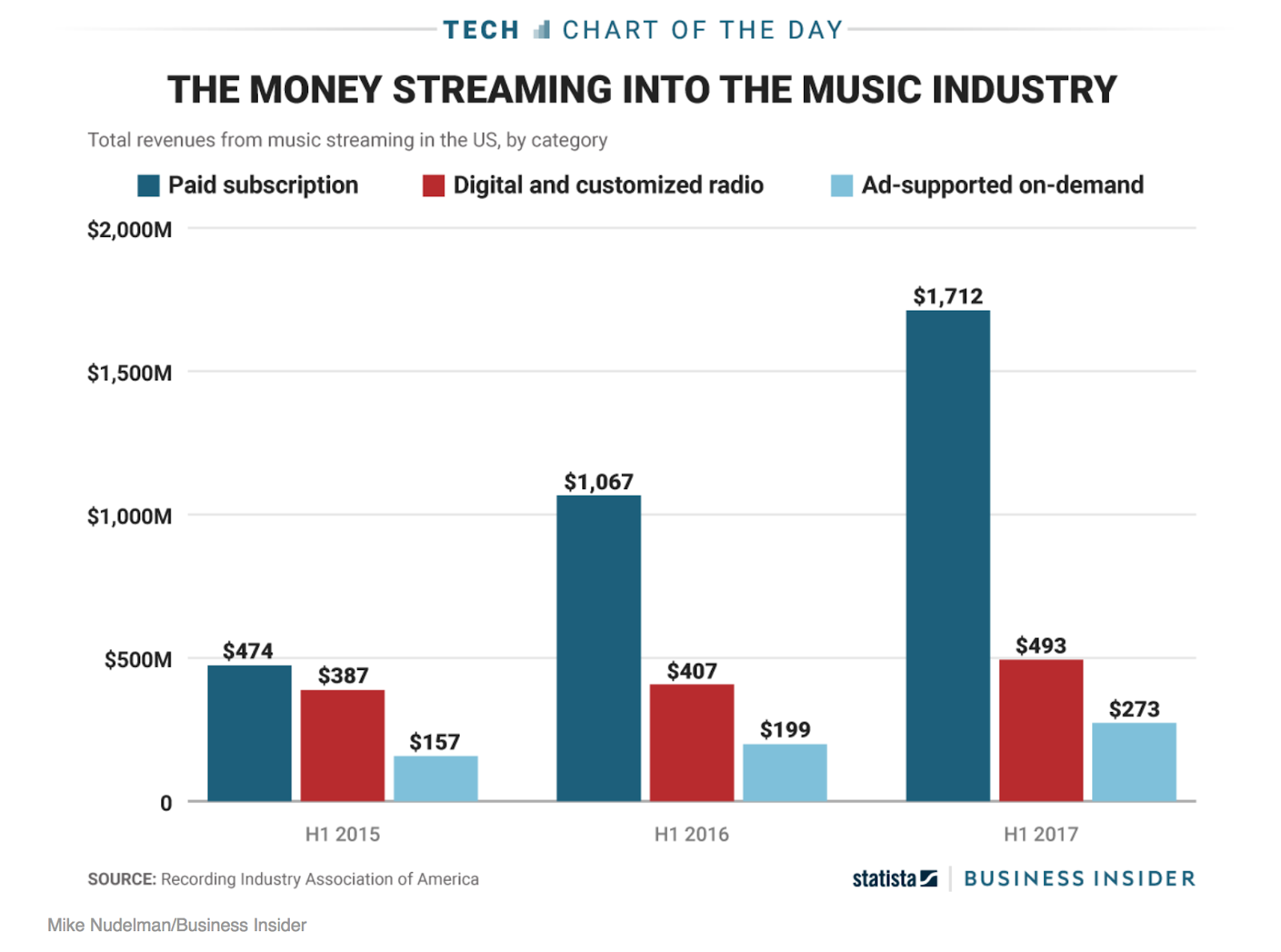
Music Streaming Revenues
I looked at the theguardian.com and found an article which discussed the surge in music streaming via digital services such as Spotify and Apple Music. 


"Platforms such as Apple Music and Spotify plus the revival of vinyl records are helping to make the fastest annual growth in music consumption since 1998. UK consumers have bought more than 135m albums in the last year across all formats (CDs, vinyl, digital downloads and streams from subscription services such as Spotify, Apple Music). That was a 9.5% increase from 2016, which is the biggest annual rise since 1998 when the charts were dominated by artists such as Massive Attack, All Saints and the Verve. For the first time, more than half of the total number of albums bought and listened to were streamed, according to the latest figures from the UK music industry trade body, the British Phonographic Industry (BPI) based on data from the Official Charts Company".


I looked at billboard.com and found an article which described a bit about the music streaming revenue report for 2017: "US digital revenue grew 15 percent in 2017 from $5.65 billion to $6.5 billion. In 2016, there was a 53 percent increase in music streaming from $2.2 billion to $3.4 billion". 

I also found a report called Global Music Report 2017: Annual State of The Industry by IFPI and I found the image that you can see on the right and the image that you can see below. I also discovered from this report that “in 2016, the global recorded music market grew by 5.9%, the fastest rate of growth since IFPI began tracking the market in 1997. This was a second consecutive year of global growth for the industry. Streaming has been the clear driver of this growth, with revenues surging by 60.4%. With more than 100 million users of paid subscriptions globally, streaming has passed a crucial milestone. It makes up the majority of digital revenue, which, in turn, now accounts for 50% of total recorded music revenues”.


"Streaming is now established as the most prevalent and significant format in the modern music industry, fuelling growth in almost all major markets and starting to unlock the phenomenal potential within developing territories. Physical sales remain significant in certain countries and for certain artists, and the vinyl revival has been a headline grabber, but streaming is the growth driver that is revolutionising the business. By the end of 2016, IFPI estimates that the number of paid subscription accounts reached 97 million worldwide. With the rapid growth of family plans, where several members of the same household can share a family subscription, IFPI estimates that there were approximately 112 million users worldwide of these 97 million paid subscription accounts".

YouTube Red
YouTube has had a subscription option for a while (launched Oct 2015), but it seems there will soon be either 2 options or a renewed, rebranded option.

YouTube Red is its current $9.99/month option, offering:
  • no ads
  • video downloads
  • exclusive content (which they're expanding)
  • the ability to continue playing YouTube when switching to other apps

Sunday, 3 September 2017

INDUSTRY: Web 2.0

Web 2.0, simply, is what people call new ways of showing or using things on the internet (the current state of online technology). 

It's considered beneficial because it is easy for people to publish their work, connect with other people and share and exchange information. Web 2.0 is mainly about user-generated and interactive content. e.g. wikis, blogs, social media. 

Before Web 2.0, internet users could just read information on web pages. With Web 2.0, users can interact with the site and add information and also have greater collaboration among content providers, enterprises and other internet users. One of the most significant differences between Web 2.0 and Web 1.0 (the traditional World Wide Web - WWW), the previous version, is that information on websites is not only written by the website author. Originally, data was posted on web sites and users simply viewed or downloaded content. Increasingly, users have more input into the nature of the web content and in some cases have real control over it.

The internet technology which is used for Web 2.0 is not different from the old internet technology, but the ways people use the web/internet has changed.

Examples of Web 2.0
Wikipedia
Facebook
YouTube
Twitter

There are many theorists which explore the concept of 'web 2.0' and 'convergence' such as Julian McDougall (2005), Tim O'Reilly (2005), Dan Gillmor, David Gauntlett and Henry Jenkins.