...
...
THE SCRIPT:
Hi there, my name is Evie Gibbons and I will be introducing my A2 Media Studies blog, Lilac City Records. This year we have to make a music video, website and digipak for a music artist. I am still unsure of who I am going to pick, I am stuck between three, a male artist called Sakima, a male DJ called Jakwob and a female electropop singer called Astrid S. I have decided the song I would pick for each of these artists however, for Sakima it would be 'What I Know Now', for Jakwob it would be 'Somebody New' and for Astrid S it would be 'Bloodstream'. I have also already set up a twitter and instagram social media account for the artist; at the moment the social media account name is sakima_music, until I finally decide the artist that I am definitely picking. In this blog you will see my journey of how I got to the final products of a music video, digipak and website, you will see things like music video analyses, website analyses, pre-production and post-production lists, podcasts, vodcasts, research of all kinds, audience feedback, audience analyses etc. I am really looking forward to getting started with the A2 Coursework properly and getting inspired by other media products which will influence my work. I hope you enjoy looking through my blog and seeing all my work for A2 Media Coursework. I also hope that this blog inspires you and provides you with a lot of useful information. Also, I will be posting many podcasts throughout the production process which will be updating where I am, what I plan to do and what I have done so far. So, until the next podcast, thanks, bye!
Sunday, 23 July 2017

Saturday, 22 July 2017
MVid EG1: Astrid S - Such A Boy
POSSIBLE INFLUENCES:
1. The excessive use of colour correction and colour gels (for lighting - colourful lighting).
3. The locations e.g. indoor in a bathroom, in a bowling alley, in a bedroom, at a party full of people.
Act: Astrid S
Track: Such A Boy
Year: 2017
Director:
Genre: Electropop
Main Audience: Females (15-24)
There are 18 shots in the first 30 seconds. That estimates that each shot lasts 1.6 seconds.
...
...
There is frequent use of colour correction and colourful lighting (created with colour gels) in this music video. I am really inspired to use this for my music video, I really like it.
Andrew Goodwin's '6 conventions of music videos' can apply to this music video. There are frequent close up shots used of the singer, Astrid S lip syncing. There are also frequent electro pop genre signifiers used such as the excessive colour correction/colourful lighting (created with colour gels).

 Laura Mulvey's 'male gaze' can be somewhat exploited in this video because of how the artist is glamourised throughout with either pink lipstick or lipgloss, lilac nail varnish, black mascara, either silver earrings studs or bangles, foundation, blusher and black eyeshadow. You can denote that her eyebrows are plucked and shaped nicely also. The pink lighting on her for example at the start as you can see in the image on the left, helps to further glamorise her and make her appear very feminine. The shot on the left is of a boy about to kiss the artist's neck which is not something which would attract a young tween audience but instead, an older teen audience aged 16-25.
 There are also many shots of the artist showing her shoulders in thin strapped tops/dresses. She is also a white caucasian blonde female so this is a normative representation of females. She also has mid-length long hair which further enforces this normative representation. Later on in the video you see a close up two shot high angled shallow field of focus shot of Astrid S looking in direct audience address with the boy in the background out of focus. In this shot she is wearing a thin strapped pink ribbed tight dress which shows her cleavage - this is clear evidence of the 'male gaze' theory being exploited.
 She is also eating candy floss at the same time - the fact that she is looking in direct address while biting into something has sexual connotations, therefore glamourising and sexualising Astrid S which can attract a male audience. It also signifies that her audience are not young (e.g. tweens aged 10-13) but instead they are young adults aged 16-25. However, the candyfloss element could be considered as an attempt to create a playful vibe to the music video which could therefore attract a younger audience (aged 13-15).
You could say the 'female gaze' is also being exploited in this video due to the high key colourful lighting clearly glamorising the male character as you can see in this image below.

 The boy is sucking on something or has something slightly in his mouth in the lower image, the female gaze being exploited because this is a sexualised pose that you see male models do for modelling images - as you can see here in this example on the right for this 'Spicebomb' perfume. There is lighting coming from many different angles in this image on the lower right, to create a glamourised effect on the facial features and skin. For example you can see some sections of the face are dark blue and some are pink. The jaw/neck, which is a glamorised feature of the male face, has clearly been purposely lighted a different colour to the rest of the face.
 This boy character is being glamorised and sexualised by being in this pose which connotes that the Astrid S's (the artist) audience is not young but instead is older teens (aged 16-25).
 There is also use of direct personal address in the video from the singer, Astrid S. This creates a personal connection between the artist and audience/fans. This is a common convention of music videos of any genre. While she is with her lover character in the video she is looking at the audience while the lover character is looking at her or doing something to her like kiss her neck.
I also noticed this technique/effect was used in Astrid S's music video for 'bloodstream'. This makes the audience really empathise with her and relate to what is going on in the video, this can be tied nicely with Dennis McQuail's 'Uses and Gratifications theory' - the personal identity gratification is relevant here - the female audience members at a similar age to Astrid S (aged 20) or younger (aged 16-18) can relate and identify with Astrid S.
1. The excessive use of colour correction and colour gels (for lighting - colourful lighting).
3. The locations e.g. indoor in a bathroom, in a bowling alley, in a bedroom, at a party full of people.
Act: Astrid S
Track: Such A Boy
Year: 2017
Director:
Genre: Electropop
Main Audience: Females (15-24)
There are 18 shots in the first 30 seconds. That estimates that each shot lasts 1.6 seconds.
...
...
There is frequent use of colour correction and colourful lighting (created with colour gels) in this music video. I am really inspired to use this for my music video, I really like it.
Andrew Goodwin's '6 conventions of music videos' can apply to this music video. There are frequent close up shots used of the singer, Astrid S lip syncing. There are also frequent electro pop genre signifiers used such as the excessive colour correction/colourful lighting (created with colour gels).

 Laura Mulvey's 'male gaze' can be somewhat exploited in this video because of how the artist is glamourised throughout with either pink lipstick or lipgloss, lilac nail varnish, black mascara, either silver earrings studs or bangles, foundation, blusher and black eyeshadow. You can denote that her eyebrows are plucked and shaped nicely also. The pink lighting on her for example at the start as you can see in the image on the left, helps to further glamorise her and make her appear very feminine. The shot on the left is of a boy about to kiss the artist's neck which is not something which would attract a young tween audience but instead, an older teen audience aged 16-25.
 There are also many shots of the artist showing her shoulders in thin strapped tops/dresses. She is also a white caucasian blonde female so this is a normative representation of females. She also has mid-length long hair which further enforces this normative representation. Later on in the video you see a close up two shot high angled shallow field of focus shot of Astrid S looking in direct audience address with the boy in the background out of focus. In this shot she is wearing a thin strapped pink ribbed tight dress which shows her cleavage - this is clear evidence of the 'male gaze' theory being exploited.

You could say the 'female gaze' is also being exploited in this video due to the high key colourful lighting clearly glamorising the male character as you can see in this image below.

 The boy is sucking on something or has something slightly in his mouth in the lower image, the female gaze being exploited because this is a sexualised pose that you see male models do for modelling images - as you can see here in this example on the right for this 'Spicebomb' perfume. There is lighting coming from many different angles in this image on the lower right, to create a glamourised effect on the facial features and skin. For example you can see some sections of the face are dark blue and some are pink. The jaw/neck, which is a glamorised feature of the male face, has clearly been purposely lighted a different colour to the rest of the face.
 This boy character is being glamorised and sexualised by being in this pose which connotes that the Astrid S's (the artist) audience is not young but instead is older teens (aged 16-25).
 There is also use of direct personal address in the video from the singer, Astrid S. This creates a personal connection between the artist and audience/fans. This is a common convention of music videos of any genre. While she is with her lover character in the video she is looking at the audience while the lover character is looking at her or doing something to her like kiss her neck.
I also noticed this technique/effect was used in Astrid S's music video for 'bloodstream'. This makes the audience really empathise with her and relate to what is going on in the video, this can be tied nicely with Dennis McQuail's 'Uses and Gratifications theory' - the personal identity gratification is relevant here - the female audience members at a similar age to Astrid S (aged 20) or younger (aged 16-18) can relate and identify with Astrid S.
Website: IDEA 1
...

...
This is my first idea of a layout for the home page. I put the menu (with the Home, Bio etc...) in the footer and then froze the footer so that when someone scrolls down, the menu always stays at the bottom of the page.
I inserted a picture of the artist (for the moment until I get pictures of my own) and made it fill the entire page.
I also added a social media bar and put it on the right hand side of the menu.
Wednesday, 19 July 2017
GENRE: Carol Vernallis 'Experiencing Music Video'
Carol Vernallis (2004) 'Experiencing Music Video
Carol Vernallis argues that music videos derive from the songs they set. The music comes first - the song is produced before the video has been created - and the director normally designs images with the song as a guide.

'In music video, what is concealed and what is revealed serve to encourage multiple viewings by engaging the viewer in a process of reconstructing, interpolating or extrapolating a story behind the scenes that are actually visible. When the narrative mode is present even fleetingly, it creates an aura of mystery, a sense that things need to be puzzled out'.
Videos use ellipsis in such an extreme fashion that causality is often absent.
"Music video presents a range all the way from extremely abstract videos emphasising colour and movement to those that convey a story. But most videos tend to be nonnarrative. An Aristotlean definition - characters with defined personality traits, goals, and a sense of agency encounter obstacles and are changed by them - describes only a small fraction of videos, perhaps one in fifty.
'I argue that the lyrics constitute no more and no less than one of many strands a video must weave together.'
GENRE: Andrew Goodwin's 6 Features of Music Videos
Andrew Goodwin Relationship Between Lyrics, Visuals and Music:

1. Music videos demonstrate genre characteristics.
2. There is a relationship between lyrics and visuals. The lyrics are represented with images.
3. There is a relationship between music and visuals. The tone and atmosphere of the visual reflects that of the music.
4. The demands of the record label will include the need for lots of close ups of the artist and the artist may develop motifs which recur across their work (a visual style).
5. There is reference to the notion of looking (mirrors, screens within screens), particularly voyeuristic treatment of the female body.
6. There is often intertextual reference to films, TV programmes, other music videos etc.
NARRATIVE: Todorov's 5-Part Narrative Structure
 1. A state of equilibrium at the outset.
Everything is balanced evenly - there is no problem - everything is calm.
2. A disruption of the equilibrium by some action.
Something happens to upset the balance - chaos - things have gone wrong.
Something happens to upset the balance - chaos - things have gone wrong.
3. A recognition that there has been a disruption.
What has upset the balance is recognised. The characters see what has changed.
What has upset the balance is recognised. The characters see what has changed.
4. An attempt to repair the disruption.
People make an effort to bring the balance back - to restore equilibrium - the characters will have to work to make things different.
People make an effort to bring the balance back - to restore equilibrium - the characters will have to work to make things different.
5. A reinstatement of the equilibrium.
The balance is back - equilibrium is restored - all the problems are sorted out.
The balance is back - equilibrium is restored - all the problems are sorted out.
NARRATIVE: Roland Barthes' 5 Codes
EASSC:
 The Enigma code - the audience is intrigued by the need to solve a problem.
The Action code - the audience is excited by the need to resolve a problem.
The Semantic code - the audience is directed towards an additional meaning through connotation.
The Symbolic code - the audience assumes that a character dressed in black is evil and forms expectations of his/her behaviour on this basis.
The Cultural code - the audience derives meaning in a text from shared cultural knowledge about the way the world works.
Thursday, 15 June 2017
MVid EG3: The 1975 - Sex
POSSIBLE POINTS OF INFLUENCE FOR MY MUSIC VIDEO:
1. The trippy colours used.
2. The use of naturalistic locations.
3. The footage of the teen characters doing naturalistic teenage activities.
4. The footage of the teen couple kissing, touching each other and on top of each other.
5. The performance footage of the band.
Adam Powell (2013)
Act: The 1975
Track: Sex
Genre: indie rock
Main Audience: Females and Males (16-24)
The first 30 seconds consists of dialogue with 4 shots. From 0:30 to 1:00, there are 19 shots. This estimates that each shot lasts 1.6 seconds.
...
...
There narrative to this music video is non-linear, the end is at the start where the male character gets caught by the police.
 There is a mix of narrative and performance footage in this video, so, Simon Perth's performance, concept and narrative theory can be applied here. There are shots of the band performing with instruments such as electric guitar, drum kit, this all creates verisimilitude for the video. The narrative footage blurs with the performance footage at points for example when the band perform around the couple having sex/on top of each other kissing on a worn out discoloured mattress.
There is very naturalistic colour correction to almost no colour correction used at all in this music video with a slightly grainy effect on all the footage. This effect has been used to connote the naturalistic and gritty side of the video. The 1975 band has an already existing branding which consists of the colours black and white, smoking cigarettes, wearing black dark clothing, having tattoos, wearing doc martens etc. They have quite a grungy, dark, gritty style, similar to Arctic Monkeys.
There is also a lot of nudity (female nudity) within this video and mature, explicit inappropriate behaviour such as smoking weed and having sex.
I believe this video would get an 18 age rating from the BBFC. When you watch this video on YouTube, the vevo age verification screen comes up where you have to confirm that you are 18 years old or older.
MVid EG2: Halsey - Ghost
POSSIBLE POINTS OF INFLUENCES FOR MY MUSIC VIDEO:
1. The coloured lighting, neon colours, pastel colours
2. The slow motion effect on the characters moving.
3. The costumes used in the video e.g. the blue bob wig, pink bob wig, red lipstick, choker, black eyeshadow, black eyeliner etc.
Malia James (2015)
Act: Halsey
Track: Ghost
Genre: electropop
Main Audience: Females (13-24)
There are 11 shots in the first 30 seconds. This estimates that each shot lasts 2.7 seconds.
...
...
 At the start of the video, there is a medium long shot/long shot of a city with high skyscrapers and lots of banners everywhere with Chinese writing on. This denotes the setting to be urban and a 'big city' perhaps in the country of China or Japan. However, the location hasn't been intentionally anchored, it has been left as polysemic with asian signifiers through chinese script. The issue here is globalisation - where is this city - this is a city anywhere - not western or eastern which is an aspect of representation and post modernism, a refusal to accept a certain reality - any place any reality.
 There is use of a diegetic title at the start of the video. This title is the track title. There is also another title which is the track title 'Ghost' translated in Chinese.
 Andrew Goodwin argued that there are 6 features of music videos, these can be seen in this video. These are: frequent close ups of artist, genre characteristics, relationship between lyrics and visuals, relationship between music and visuals, the notion of looking and intertextual references. First of all, there is frequent use of close ups of the artist, Halsey in this video.
 There are electropop genre characteristics in this video such as the use of bright neon, primary colours throughout (created through colour gel lighting and colour correction) and the iconic, flamboyant costumes seen which are a light blue wig, a light pink wig, a choker, bright red lipstick and heavy black eye make-up.
 Laura Mulvey's male gaze' is somewhat exploited in this music video through the close ups and medium close up shots at the start of the video of Halsey and another girl's body. They are heavily glamourised through the use of high key lighting, sometimes with the use of colour gels and also colour correction. This is one of the key conventions of the electropop genre (colour correction, SFX, use of colour gels). I am influenced by this video to use colour gels for lighting in my music video on the lip syncing footage of the singer and on some of the narrative shots.
In terms of the Uses and Gratifications theory (Dennis McQuail), 3 of the gratifications apply here. Personal identity, personal relationship and diversion. Females aged 15-24 are able to identify with the female main protagonist, Halsey, in this music video. The same gratifications will apply to my music video.
There is a playful post modern deconstructionist pomo aspect to this video due to the fact that the two female main protagonists look very similar because of the wig 'bobs' they are wearing, one is wearing a short bob pink wig, the other is wearing a short bob light blue wig. The first scene is where this is most evident. The editing choice of this first scene tricks/challenges the viewer and gets them confused as to which female is Halsey (the singer/artist). At one point Halsey is on the right while kissing and touching the other girl and then at another point Halsey is on the left side instead. This confusion is also created through the shot choices - through, for example the side on close up two shots of the two female characters, it is very hard to distinguish which female protagonist/character is Halsey.
Also, it is clearly denoted that the narrative and performance have been blurred. Halsey is blurring the narrative and performance. The same colour correction is used on the lip syncing footage of the singer and the narrative footage of Halsey with the other female character. However, in the narrative shots, Halsey has a short light blue bob but in the performance shots, has significantly longer light blue hair. Halsey's bob hair in the narrative shots matches the hair of the other female character in the video intentionally.
In terms of editing style, a slow motion effect has been used on all of the footage. This creates a flowing effect.
Information on electropop genre music video conventions gathered:
1. Use of colour correction, colour gels in lighting to look colourful
2. Flamboyant costumes - colourful, vibrant costumes
1. The coloured lighting, neon colours, pastel colours
2. The slow motion effect on the characters moving.
3. The costumes used in the video e.g. the blue bob wig, pink bob wig, red lipstick, choker, black eyeshadow, black eyeliner etc.
Malia James (2015)
Act: Halsey
Track: Ghost
Genre: electropop
Main Audience: Females (13-24)
There are 11 shots in the first 30 seconds. This estimates that each shot lasts 2.7 seconds.
...
...

 There is use of a diegetic title at the start of the video. This title is the track title. There is also another title which is the track title 'Ghost' translated in Chinese.


 Laura Mulvey's male gaze' is somewhat exploited in this music video through the close ups and medium close up shots at the start of the video of Halsey and another girl's body. They are heavily glamourised through the use of high key lighting, sometimes with the use of colour gels and also colour correction. This is one of the key conventions of the electropop genre (colour correction, SFX, use of colour gels). I am influenced by this video to use colour gels for lighting in my music video on the lip syncing footage of the singer and on some of the narrative shots.
In terms of the Uses and Gratifications theory (Dennis McQuail), 3 of the gratifications apply here. Personal identity, personal relationship and diversion. Females aged 15-24 are able to identify with the female main protagonist, Halsey, in this music video. The same gratifications will apply to my music video.
There is a playful post modern deconstructionist pomo aspect to this video due to the fact that the two female main protagonists look very similar because of the wig 'bobs' they are wearing, one is wearing a short bob pink wig, the other is wearing a short bob light blue wig. The first scene is where this is most evident. The editing choice of this first scene tricks/challenges the viewer and gets them confused as to which female is Halsey (the singer/artist). At one point Halsey is on the right while kissing and touching the other girl and then at another point Halsey is on the left side instead. This confusion is also created through the shot choices - through, for example the side on close up two shots of the two female characters, it is very hard to distinguish which female protagonist/character is Halsey.
Also, it is clearly denoted that the narrative and performance have been blurred. Halsey is blurring the narrative and performance. The same colour correction is used on the lip syncing footage of the singer and the narrative footage of Halsey with the other female character. However, in the narrative shots, Halsey has a short light blue bob but in the performance shots, has significantly longer light blue hair. Halsey's bob hair in the narrative shots matches the hair of the other female character in the video intentionally.
In terms of editing style, a slow motion effect has been used on all of the footage. This creates a flowing effect.
Information on electropop genre music video conventions gathered:
1. Use of colour correction, colour gels in lighting to look colourful
2. Flamboyant costumes - colourful, vibrant costumes
MVid EG2: Chase Atlantic - Swim
POSSIBLE POINTS OF INFLUENCE FOR MY MUSIC VIDEO:
1. The clothing and hairstyles of the trio.
2. The club location with lots of flashing and colourful lights.
3. The purple colour correction used on the outdoor footage on the cliff.
4. The drone shots of the rocks in the ocean and the settings.
5. The diegetic titles at the start for the artist name and the track name.
6. The diegetic titles of some of the lyrics of the song.
7. The editing style - cutting to the beat
8. The flashing effect on the footage.
Act: Chase Atlantic
Track: Swim
Year: 2017
Genre: Hip Hop, Electronic
Main Primary Audience: Females and Males (15-24)
...
...
Throughout this music video, you can see multiple costume changes from the artist.
You can also see in this video, many locations used, for example, at the start of the video the artist trio stands on a cliff, then later you see shots of the lead singer of the trio in a club setting.
 This music video has a title at the start with the artist's name - 'Chase Atlantic'. There is also a title before that which warns the audience/viewer that this video has a lot of flashing image and can be harmful to people with epilepsy. This is become quite an important thing to do lately, informing the viewer about the video in case they have epilepsy.
 For this music video, Simon Ferth's 'Narrative, Performance, Concept' theory can be somewhat applied. However, in this video you can only mainly see solely performance from the artist. There is no narrative evident in this video.
 Andrew Goodwin's 6 conventions or features of music videos theory can be reflected in this music video example. There are multiple genre signifiers of hip hop such as the dancing footage of the artist, the style of dancing has a lot of hip hop connotations. The second convention he states is that there is a relationship between the visuals and the lyrics. As you can see in the image below, there is an animation of pills raining down - this appears on screen on the lyric line of the track "Pop a couple pills in the daytime".
 The main thing to note about this music video is the frequent use of special effects or SFX. As you can see on the right, there is an animation within the video of pills falling down like rain. Also in the image above on the left, there is use of layering over a shot of a human prototype and a medium shot of the lead singer of the trio, heavy purple colour correction, glitch effect and a human prototype animation. This combination creates quite a striking visual as you can see.
There is also a very fast editing pace and striking editing style for the video. The visuals on screen cut to the beat of the song and there is a flashing effect used on the footage and the transitions between shot takes.
1. The clothing and hairstyles of the trio.
2. The club location with lots of flashing and colourful lights.
3. The purple colour correction used on the outdoor footage on the cliff.
4. The drone shots of the rocks in the ocean and the settings.
5. The diegetic titles at the start for the artist name and the track name.
6. The diegetic titles of some of the lyrics of the song.
7. The editing style - cutting to the beat
8. The flashing effect on the footage.
Act: Chase Atlantic
Track: Swim
Year: 2017
Genre: Hip Hop, Electronic
Main Primary Audience: Females and Males (15-24)
...
...
Throughout this music video, you can see multiple costume changes from the artist.
You can also see in this video, many locations used, for example, at the start of the video the artist trio stands on a cliff, then later you see shots of the lead singer of the trio in a club setting.
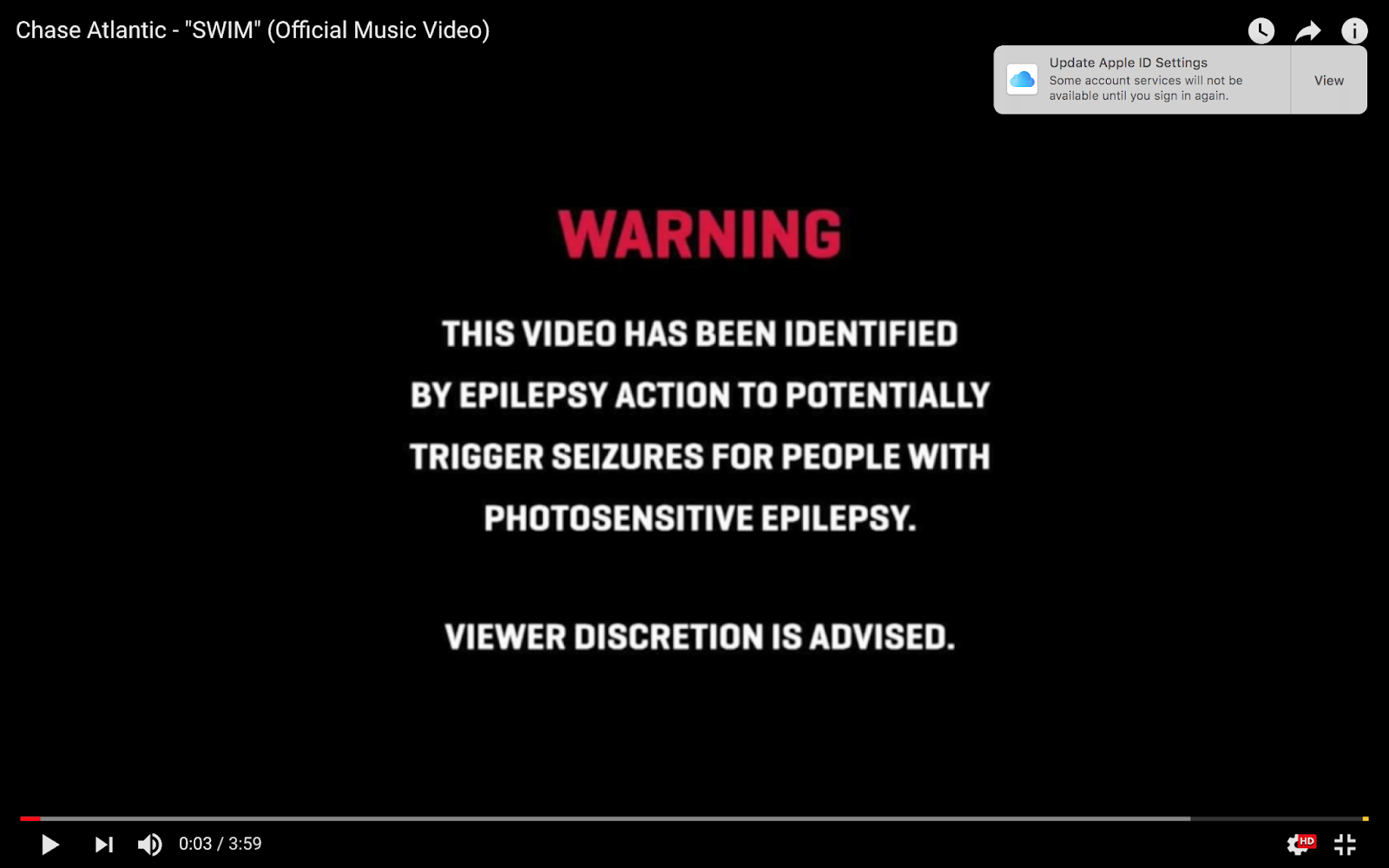 This music video has a title at the start with the artist's name - 'Chase Atlantic'. There is also a title before that which warns the audience/viewer that this video has a lot of flashing image and can be harmful to people with epilepsy. This is become quite an important thing to do lately, informing the viewer about the video in case they have epilepsy.
 For this music video, Simon Ferth's 'Narrative, Performance, Concept' theory can be somewhat applied. However, in this video you can only mainly see solely performance from the artist. There is no narrative evident in this video.
 Andrew Goodwin's 6 conventions or features of music videos theory can be reflected in this music video example. There are multiple genre signifiers of hip hop such as the dancing footage of the artist, the style of dancing has a lot of hip hop connotations. The second convention he states is that there is a relationship between the visuals and the lyrics. As you can see in the image below, there is an animation of pills raining down - this appears on screen on the lyric line of the track "Pop a couple pills in the daytime".
 The main thing to note about this music video is the frequent use of special effects or SFX. As you can see on the right, there is an animation within the video of pills falling down like rain. Also in the image above on the left, there is use of layering over a shot of a human prototype and a medium shot of the lead singer of the trio, heavy purple colour correction, glitch effect and a human prototype animation. This combination creates quite a striking visual as you can see.
There is also a very fast editing pace and striking editing style for the video. The visuals on screen cut to the beat of the song and there is a flashing effect used on the footage and the transitions between shot takes.
Wednesday, 14 June 2017
MVid EG1: Somewhere Else - Move Together
POSSIBLE POINTS OF INFLUENCE FOR MY MUSIC VIDEO:
1. The different coloured lighting, e.g. lilac, purple, dark blue lighting
2. The narrative of a teenage couple living together in a small apartment doing what teenage couples do e.g. kissing, looking at social media on their phones, chilling out on a sofa in a living room, listening to music through speakers, dancing.
3. Fast pace editing
4. Close up shots of body, couple touching each other,
5. The water on skin idea.
Act: Somewhere Else (feat. Majid Jordan)
Track: Move Together
Genre: Electronic
Music Video Length: 03:23
Target Audience: Male and Female Teens (15-24)
Somewhere Else is an electronic hip hop artist that is not very well known at all. This music video for Somewhere Else's only song, Move Together, is directed by Helmi.
There are 18 shots in the first 30 seconds. This would estimate that each shot lasts 1.6 seconds.
Music Video:
...
 There is an intertitle at the start of this music video which is the artist logo. This is common to see in the opening shot.
...
 The opening shot is a two shot of two teenagers, female and male. They are sitting far apart to connote there is a distance between them. The fact that they are on their phones connotes that they are bored together.
 There is heavy use of special effects in this music video. Firstly, there is use of 360 degree, anticlockwise camera movements. These camera movements are used to create a 'trippy' drug vibe to the video and connote a drug influenced state.
Secondly there is heavy use of colour correction and colourful lighting used in the video with colours such as purple, red, blue, green.
There is also use of animation in this video - there are hundreds of naked human prototypes of the two main protagonists. They touch, kiss and feel up each other. It is clearly denoted that the human prototypes are the two characters we see at the start touching and getting sexual with each other.
1. The different coloured lighting, e.g. lilac, purple, dark blue lighting
2. The narrative of a teenage couple living together in a small apartment doing what teenage couples do e.g. kissing, looking at social media on their phones, chilling out on a sofa in a living room, listening to music through speakers, dancing.
3. Fast pace editing
4. Close up shots of body, couple touching each other,
5. The water on skin idea.
Somewhere Else - Move Together (feat Majid Jordan)
Helmi (2016)
Track: Move Together
Genre: Electronic
Music Video Length: 03:23
Target Audience: Male and Female Teens (15-24)
Somewhere Else is an electronic hip hop artist that is not very well known at all. This music video for Somewhere Else's only song, Move Together, is directed by Helmi.
There are 18 shots in the first 30 seconds. This would estimate that each shot lasts 1.6 seconds.
Music Video:
...
 There is an intertitle at the start of this music video which is the artist logo. This is common to see in the opening shot.
...


Secondly there is heavy use of colour correction and colourful lighting used in the video with colours such as purple, red, blue, green.
There is also use of animation in this video - there are hundreds of naked human prototypes of the two main protagonists. They touch, kiss and feel up each other. It is clearly denoted that the human prototypes are the two characters we see at the start touching and getting sexual with each other.
AUDIENCE: U+G Theory
WHAT I CAN APPLY
I believe that the my music video that I will create will fulfil the 3 gratifications - personal identity, personal relationships and escapism. People in the audience (mainly females aged 15-24) will be able to relate and identify with the main female protagonist on the screen. People (males and females aged 15-24) will be able to relate to the actions of the couple characters in the video for example going to fast food restaurant together, kissing, touching each other, it will be a talking point. They would relate to the kinds of things shared and done in the relationship on screen.
The Uses and Gratifications theory is the idea that the members of the audience are not passive but take an active role in interpreting and integrating media into their own lives. The theory approaches why people actively seek out specific media forms to fulfil their needs. The audience choose the media to meet/fulfil their needs. These needs can also be described as specific gratifications. There are 4 gratifications.
These gratifications are:
- Escapism/Diversion - Escape from everyday tasks/problems.
- Personal Identity - This means self understanding and trying to relate to people in the media (characters/actors).
- Personal Relationships - A talking point. The audience relate with the kinds of relationships shown in the media e.g. by relating to the issues risen in the relationships shown or the kinds of things shared and talked in the relationships etc...
- Surveillance - This means using media to find out whats around us and to be informed with information.

Katz and Blumler's variation (development) of U+G
These two people tweaked McQuail's theory. 'Uses and Gratifications' (Katz and Blumler) research has identified many potential pleasures of genre, including the following:
One pleasure may simply be the recognition of the features of a particular genre because of our familiarity with it. Recognition of what is likely to be important (and what is not), derived from our knowledge of the genre, is necessary in order to follow a plot.
Genres may offer various emotional pleasures such as empathy and escapism - a feature which some theoretical commentaries seem to lose sight of. Aristole, of course, acknowledged the special emotional responses which were linked to different genres.
Goals for media use can be grouped into five uses. The audience wants to:
1. Be informed
2. Identify with characters of the situation in the media environment
3. Simple entertainment
4. Enhance social interaction
5. Escape from the stresses of daily life.
REPRESENTATION: Laura Mulvey's 'Male Gaze'

I would possibly think to exploit this theory in my own music video e.g. by having Close Ups of a female getting touched by a male character.
Laura Mulvey is a british, feminist, film theorist.
She created the "male gaze theory" in her 1975 essay called "Visual Pleasure and Narrative Cinema".
The 'male gaze' consists of three perspectives:
- the person behind the camera
- the characters within the representation or film itself
- the spectator
The male gaze theory happens when the camera puts the audience into the perspective of a heterosexual man e.g. having shots of the curves of a woman's body.
The woman is usually displayed on two different levels: as an erotic object both for the characters within the film and for the spectator who is watching the film. The man comes across as the dominant power within the created film fantasy. The woman is passive to the active gaze of a man. This adds an element of patriarchal order, and is often seen in "illusionistic narrative film".
Mulvey argues that, in mainstream cinema, the male gaze typically takes precedence over the 'female gaze', reflecting an underlying power asymmetry.
Subscribe to:
Posts (Atom)